


Georgia Kinchin’s App for Survivors
Words Povel Torudd
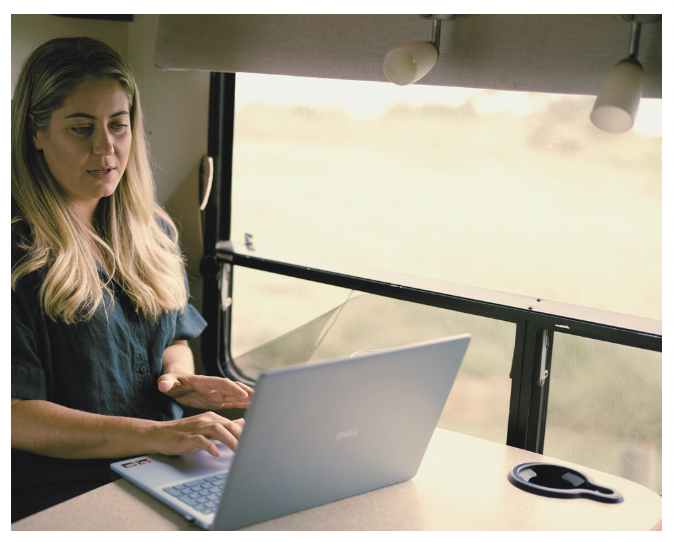
From the beaches of Kingscliff to the quiet backroads of the Tweed Valley, Georgia Kinchin’s Winnebago has seen more than most tech startups ever will. But then, Heard – Survivor Space isn’t your usual app story. And Georgia isn’t your usual founder.
She built the entire platform while living on the road with her two daughters. No investors. No office. Just grit, purpose and the belief that something had to exist, because nothing else did.
And it all started in a walk-in wardrobe in Queensland.
“I was scribbling on Post-Its, just trying to stay sane in a very challenging situation,” she says. “I had no idea it would turn into this.”
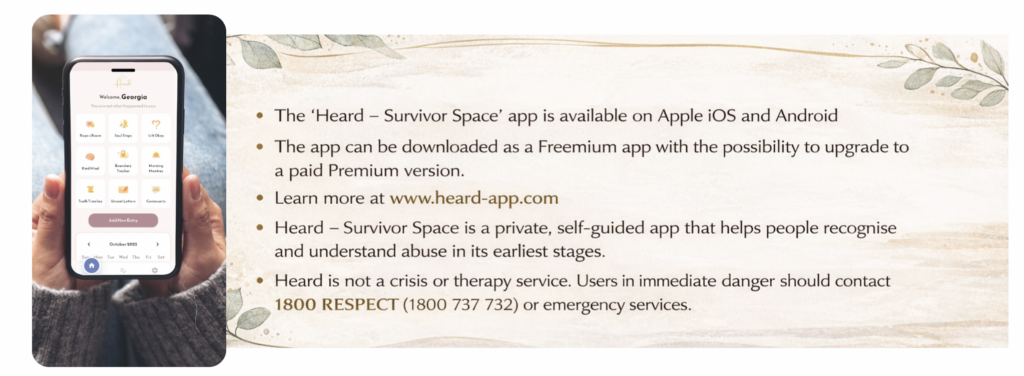
Heard is a self-guided app designed to help people recognise coercive control and emotional abuse in its earliest stages, long before crisis services or legal intervention feel possible.
The idea came at a low point. Georgia had left a coercive relationship marked by years of psychological and emotional control. Moving back to the area, mainly so her daughters could stay close to their father, meant confronting patterns she thought she had escaped.
“I thought I was doing the right thing at the time,” she says. “But I walked straight back into fear.”
There were small signs. Self doubt. Stomach knots. Watching her eldest cry herself to sleep repeatedly. Moments that built up until one night she started writing everything down, not for business, just for clarity.
“If I have all these questions and lack of clarity in the moment, I assumed there’d be others out there feeling the same.”
It turns out, many Australians are facing that same questions. According to the Australian Bureau of Statistics, 4.2 million adults have experienced some form of partner violence, emotional abuse or economic control since the age of 15. Femicide numbers are steadily climbing in Australia, year on year, and we saw unfortunate evidence of this in the Tweed region towards the end of 2025. A year that also set a nationwide femicide record in Australia.
Yet many never seek help, simply because there are no visible bruises. Just confusion, self-doubt and a quiet hope for things to get better.
That’s the space Heard was built for. Not just at the crisis point, but the weeks and months before, when someone senses something is wrong but cannot yet name it. Typically at this stage, many victims don’t feel that their own situation warrants a therapist or professional help, when the opposite couldn’t be truer.
Georgia imagined a private app, almost like a phone within your phone. “Somewhere to track behaviours, document events, even just reflect without judgment,” she says.
There wasn’t funding waiting. Georgia was working solo, parenting full-time and rebuilding her life from the ground up. She taught herself the language of tech, mapped features on whiteboards inside her van and found quiet corners of the Tweed Coast to park and work.
“I’ve been everywhere,” she laughs. “From Kingscliff to Pottsville. Working in cafes. Sometimes just hotspotting from a carpark or campsite while the kids were asleep.”
Her motivation was never startup success. It was survival, turned outward.
“When you’re in abuse, you don’t suddenly wake up and know it’s abuse,” she says. “You doubt your memory. Your instincts. Yourself. If I’d had something like Heard back then, it would have changed everything for me.”
The app launched quietly in December. Then came an unexpected spotlight. A feature on 7News and a cover story on Startup Daily sparked close to a thousand downloads in a matter of days and more than 500 public comments from people sharing support, gratitude and stories that echoed Georgia’s own.
“The organic download data shows just how many people in Australia are sitting in silence, trying to make sense of what’s happening. Now they can access support earlier and find a way forward.”
The traction continues and currently about 50 people join every day. Survivors, therapists and legal experts have taken notice too. Two respected voices in domestic violence prevention have joined Heard’s advisory board to help guide its growth and ensure it stays true to its mission. Dr Anastasia Powell, a criminologist and gender-based violence prevention expert from RMIT, brings deep research knowledge. Simone O’Brien, a survivor and national advocate, adds vital lived experience that keeps the platform survivor-led and practical.
Despite growing recognition, Georgia remains grounded in the Tweed Coast rhythm. Chinderah for coffee. Kingscliff for a breather. Fingal Head when the ocean feels like therapy.
“This place held me when I didn’t know how to ask for help during an equally challenging and productive time in my life,” she says. “That matters.”
The app itself is intentionally gentle. Users can journal with trauma-aware prompts, track behaviours over time, reflect weekly and document experiences in a secure, encrypted space. It is not therapy. It is not a hotline. It is a companion for the moment when someone quietly asks, “Is this okay?”
“I still use Heard myself,” Georgia says. “Healing isn’t linear. Sometimes you need a place to check in with your own truth.”
Her dream has always been simple. Quiet Sunday mornings. Both girls jumping into bed. No fear. No tension. Just family time, laughter and light.
There is no corporate office behind Heard. No glossy startup façade. One woman, a Winnebago, two daughters and a purpose built from pain, now shaping clarity and safety for others.
In a region known for resilience and heart, Georgia Kinchin is a different kind of hero. She didn’t chase the spotlight. She built what was missing for others to find theirs.
And from the roads of the Tweed Coast, she created something that helps people feel seen, believed and less alone.
Georgia continues to refine and expand Heard, driven by a clear goal: to make it as practical and empowering as possible for victims of abuse, both here in the Tweed and around the world. That mission is what fuels her every day.